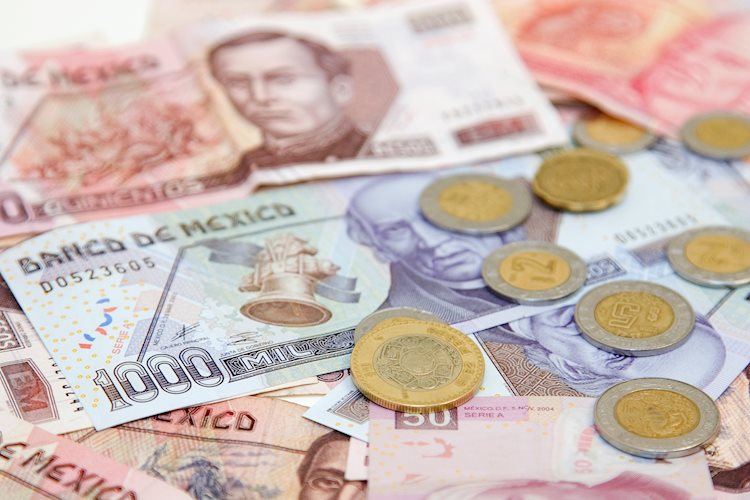
- Mexican Peso surpasses the 100-day SMA, prints two-day high.
- Mexico’s Industrial Production crushed the forecast, ahead of Banxico’s decision on Thursday.
- The Fed is expected to hold rates unchanged, but uncertainty looms about Powell’s speech.
Mexican Peso (MXN) stages a comeback climb against the US Dollar (USD) following an inflation report in the United States (US), which most likely would prevent the US Federal Reserve (Fed) from easing monetary policy faster than the expectations of market participants. At the time of writing, he USD/MXN is trading at 17.30, losing 0.44% after reaching a daily high of 17.43
Mexico´s calendar revealed that Industrial Production in October exceeded September’s data, suggesting the economy remained robust at the beginning of Q4 2023. Across the border, the US Bureau of Labor Statistics (BLS) announced that the disinflation process continued as traders brace for the Fed’s decision on Wednesday.
The Fed is not only expected to reveal its monetary policy decision but also the Summary of Economic Projections (SEP) after its meeting on Wednesday. On the day after, the Bank of Mexico (Banxico) is set to announce its own policy decision. Both central banks are expected to hold rates unchanged – at 5.25% – 5.50% in the case of the Fed, and 11.25% for Banxico.
Daily digest movers: Mexican Peso counterattacks as the USD/MXN slides further below 100-day SMA
- Industrial Production in Mexico was 5.5% in the twelve months ending in October, above September’s 3.9%. Monthly figures advanced 0.6% vs. 0.2% in the previous month.
- Mexico’s inflation data was mixed, though the disinflation process continued, as Banxico had estimated. Two officials, Governor Victoria Rodriguez Ceja and Deputy Governor Jonathan Heath, expressed that rate-cut discussions could begin in the first quarter of 2024.
- The US Consumer Price Index (CPI) for November was aligned with estimates of 3.1% YoY, lower than October’s 3.2%, with monthly readings rising 0.1%, above forecasts of 0%.
- The CPI excluding food and energy, the so-called core, stood pat at 4%, and month-over-month, at 0.3%, which aligned with forecasts, and was a tick higher than October’s 0.2%.
- Now that inflation data is out of the way and given the strengthening revealed in the US labor market by recent data, expectations of the Fed’s interest rate expectations for the next year remain volatile. Data from the Chicago Board of Trade (CBOT) has traders expecting 100 bps of rate cuts.
- On Wednesday, USD/MXN traders will scrutinize the Fed’s statement, its Summary of Economic Projections (SEP), and Chair Jerome Powell’s speech. Powell is expected to push back against market speculation of monetary policy easing for next year.
- The US Dollar Index (DXY) pared some of its losses, with the DXY down 0.07% at 104.01.
Technical analysis: Mexican Peso gathers momentum prints a two-day high around 17.29
The USD/MXN daily chart portrays the pair as neutral to upward biased, with buyers battling at the 100-day Simple Moving Average (SMA), seen as a resistance level at 17.40. If they want to regain control, a breach of the latter is needed, followed by the 17.50 mark. Upside risks will surface at the 200-day SMA at 17.54, followed by the 50-day SMA at 17.65
On the other hand, failure to reclaim the 100-day SMA, could see sellers pile in and drag prices toward the 17.20 area, ahead of a strong demand region at around the 17.00/05 range. Once hurdled, the USD/MXN could test the year-to-date (YTD) low of 16.62.
Banxico FAQs
The Bank of Mexico, also known as Banxico, is the country’s central bank. Its mission is to preserve the value of Mexico’s currency, the Mexican Peso (MXN), and to set the monetary policy. To this end, its main objective is to maintain low and stable inflation within target levels – at or close to its target of 3%, the midpoint in a tolerance band of between 2% and 4%.
The main tool of the Banxico to guide monetary policy is by setting interest rates. When inflation is above target, the bank will attempt to tame it by raising rates, making it more expensive for households and businesses to borrow money and thus cooling the economy. Higher interest rates are generally positive for the Mexican Peso (MXN) as they lead to higher yields, making the country a more attractive place for investors. On the contrary, lower interest rates tend to weaken MXN. The rate differential with the USD, or how the Banxico is expected to set interest rates compared with the US Federal Reserve (Fed), is a key factor.
Banxico meets eight times a year, and its monetary policy is greatly influenced by decisions of the US Federal Reserve (Fed). Therefore, the central bank’s decision-making committee usually gathers a week after the Fed. In doing so, Banxico reacts and sometimes anticipates monetary policy measures set by the Federal Reserve. For example, after the Covid-19 pandemic, before the Fed raised rates, Banxico did it first in an attempt to diminish the chances of a substantial depreciation of the Mexican Peso (MXN) and to prevent capital outflows that could destabilize the country.